
Tiny Glues with Huge Impact: Are Molecular Glues Nature’s Secret Engineers?

Molecular glues are monovalent small molecules, typically weighing less than 500 daltons, that change
the surface of one protein, usually an E3 ligase receptor, in order to recruit another protein, known as a
neosubstrate which aids in induction of the novel protein-protein interactions. It is a breakthrough within
the field of Targeted Protein Degradation (TPD), a therapeutic approach that aims to destroy the unwanted
or misfolded proteins responsible for causing various diseases, rather than merely inhibiting their activity.
TPD is a pioneering drug development strategy that mainly uses the ubiquitin-proteasome pathway for the
destruction of disease-causing proteins by using tiny compounds. Cancer, inflammatory, viral and
neurodegenerative disorders, particularly those with "undruggable" pathogenic protein targets that do not
have typical ligand binding sites, may be effectively treated using this strategy.
Principal Advantages of Molecular Glues and TPD:
1. Catalytic Mechanism: A Single degrader molecule can eliminate multiple copies of a pathogenic
protein, providing higher efficiency at lower concentrations compared to inhibitors.
2. Ablation of All Protein Functions: By removing the full protein, degraders can potentially
overcome drug resistance and target both enzymatic and non-enzymatic functions.
3. Targeting "Undruggable" Proteins: MGs are ideal for difficult targets because they don't require a
druggable pocket on the protein of interest.
4. Pharmacological Properties: Because MGs are often smaller than PROTACs, they may have
superior cellular absorption, membrane permeability and blood-brain barrier penetration.These
properties are important for conditions affecting the central nervous system.
Mechanisms employed by Molecular Glues:
Fundamentally these mechanisms are broadly classified into 2 major categories: non - degradative and
degradative. They both rely on characteristics of molecular glues to set connections between protein
structures which cause chemically - mediated proximity effects that trigger biological actions.
1. Non - degradative molecular glues-

Non - degradative MGs are defined as a class of MGs which do not degrade our protein of interest (POI).
These molecular glues promote the assembly of a Ternary
Complex comprising the protein of interest and an Accessory
Protein (AP), leading to modulation of downstream signaling
pathways rather than inducing degradation of the target protein.
Such binding activates or stabilizes protein interactions and
exerts biological functions.
Some well known natural molecular glues which works on this mechanism types are:
Immunosuppressants like Cyclosporin A(CsA) and Tacrolimus(FK506) inhibit calcineurin’s enzyme
activity by formation of ternary complexes with cyclophilin and FKBP12 respectively.
2. Degradative molecular glues:
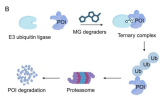
They are also called MG Degraders. They are classes of MGs that cause degradation of protein of interest.
These molecular glues form Ternary Complexes which involve an E3
ubiquitin ligase that leads to ubiquitination and subsequent proteasomal
degradation of the POI which brings about the therapeutic effects.
It involves the MG degrader stabilizing interactions between disease -
related proteins and E3 ligases.
Some well known natural molecular glues which works on this
mechanism types are:
Steroids like Bufalin form a ternary complex of the E3 ligase ‘ZFP91’ and the transcription factor E2F2
which results in ubiquitination and subsequent proteasomal degradation of the E2F2 (POI) to exert
anticancer effects.
Various Classes of Molecular Glues of Natural Origin
Nature has gifted us with products that are a rich source of molecular glues (MGs). These natural products
that resemble MGs are characterized by their structures that vary chemically. They also have specific
interactions with cellular proteins, leading to various biological functions. The primary classes of natural
molecular glues include:
1. Polyketides as Molecular Glues: Polyketides are naturally derived products formed through
Claisen condensation. They are synthesized by a variety of plants, bacteria, and fungi. There
exists a structural diversity among polyketides that includes macrolides, polyethers, xanthones,
pyridines, and even linear structures. These molecules are clinically significant as they
demonstrate antitumour, anti-inflammatory and antioxidant properties.
Examples of polyketide molecular glues :
■ Tacrolimus (FK506): Tacrolimus is obtained from Trichoderma polysporum, a
fungal species. FK506 forms a binary complex with the target protein
FKBP12(which stands for FK506-binding protein 12), which then recruits
calcineurin to inhibit T cell activation and exhibit anti-fungal effects. Ascomycin
is a structural analog of FK506.
■ Rapamycin: Rapamycin binds to protein FKBP12 and then interacts with
mTOR, inhibiting T cell proliferation. Rapadocin, a RAPA-inspired macrocycle,
forms a ternary complex of Rapadocin-FKB12- human equilibrative nucleoside
transporter 1 (hENT1) that treats treat kidney ischemia–reperfusion injury
■ Cyclosporin A (CsA): An early identified polyketide MG from Trichoderma
polysporum, CsA forms a complex with target protein cyclophilin, which then
ultimately binds to calcineurin to inhibit its activity and induce
immunosuppression. Voclosporin is an analog of CsA.
■ Sanglifehrin A: It binds to cyclophilin A and interacts with enzyme IMP
dehydrogenase 2 to inhibit T cell proliferation by upregulating genes that produce
tumor suppression proteins p53 and p21.
■ RM-018: This compound targets cyclophilin A and KRAS
G12C gene (Kirsten rat
sarcoma viral oncogene homolog) and forms a mutation-selective covalent bond
that prevents KRAS mutant cancers.
■ Asukamycin: Asukamycin, a Streptomyces-derived compound, covalently alters
Cysteine374 in the E3 ligase to create the E3 ligase-ASU complex, which
interacts with p53 and increases its transcriptional activity to decrease tumours.
An analogue of ASU is Manumycin A (MANU A).
■ Swinholide A: Swinholide A, a polyketide isolated from marine sponge
Theonella swinhoe, prevents actin polymerization by the stabilization of G-actin
homodimers. This significantly reduces the spread of cancer. Rhizopodin and
lobophorolide are analogs of swinholide A.
2. Terpenoids as Molecular Glues: Terpenoids are a category of naturally occurring products
obtained from plants and consisting of repeating isoprene (5-carbon) units. They function as non -
degradative MGs that stabilize interactions amongst proteins, offering therapeutic benefits like
anti-inflammatory, antitumour, and anti-bacterial effects.
Examples:
■ Fusicoccin: Fusicoccin is a fungal toxin that stabilizes the interaction between
plasma membrane H+ - ATPase enzyme and the 14-3-3 protein, causing proton pump activation for stomatal opening in plants.
■ Cotylenin A: This MG is a metabolic product of Cladosporium sp. It activates H+ -ATPase via an interaction with the 14-3-3 protein. It is useful in treatment of
RAS mutant cancers by enhancing the interaction between C-RAF (a
proto-oncogene) and the 14-3-3 protein.
■ Forskolin: Derived from Coleus forskohlii, it stabilizes the interaction between
adenylyl cyclase V and adenylyl cyclase II, thereby enhancing cardiac function
and reducing blood pressure.
■ Taxol: Taxol stabilizes protein-protein interaction of alpha and beta tubulin,
thereby causing microtubule stabilization.
3. Steroid Molecular Glues: Steroids are organic molecules which consist of four
rings- three cyclohexane and one cyclopentane ring- fused together. Some steroids
have strong pharmacological effects and act as MGs.
Examples:
■ Bufalin: Bufalin is a component from Bufonis venenum known for its antitumour
properties. The ternary complex of Bufalin, E2F2 (a transcription factor) and
ZFP91 (atypical E3 ligase) causes degradation of E2F2, which leads to anti-liver
cancer effects
■ Galeterone : This MG prevents prostate cancer progression by promoting
interaction between the overexpressed androgen receptors (AR) on cells affected
by prostate cancer and E3 ligases, leading to the degradation of AR.
■ Brassinolide: Brassinolide is a steroid-based plant hormone that promotes the
interaction of BRI1, a cell - surface receptor, and BRI1-associated kinase 1
(BAK1), thereby initiating signalling pathways for plant growth.
4. Lignan Molecular Glues: Lignans are naturally occurring polymers formed by the
polymerization of two phenylpropane units. Some lignans and their derivatives can
act as molecular glues.
Examples:
■ Schisandrol B: Schisandrol B acts as an anti-inflammatory agent. Obtained from
Schisandra chinensis, it facilitates the interaction between the E3 ligase and p53,
which subsequently causes better p53 ubiquitination followed by destruction.
Conclusion and Future Considerations
Molecular glues are an excellent strategy that opens up new avenues for targeting proteins previously
considered “undruggable”. Natural molecular glues are coming up as wonderful alternatives to their
existing synthetic counterparts. These natural molecules are paving the way for precision medicine, which
is essential for developing advanced technologies and therapeutic options that are more targeted and
effective than ever before. The future lies in developing novel methods for the discovery of natural
molecular glues, including the development of computational methods and the incorporation of artificial
intelligence for predicting binding and protein-protein interactions.


Comments