
Your Medicine, Made Just for You: The future of 3D Printed Drugs.

Think of a day when your medicine is not a bland tablet but rather something which
can be printed within no time since you have the to the pharmacy. In the world of
today, this is indeed possible. It is called 3D printing of medicines and it may change
the very way we produce and use drugs. To appreciate the implications of this
technology, pharmacy students note that it integrates the pharmaceutical sciences,
engineering, and innovation in healthcare. And so, we will tackle it ‘science fiction’
on, what is the 3D Printing of Medicines To the uninitiated, 3D printing, the same as
additive manufacturing, is the process where a designer adds layers, within a
framework, to complete the outline of an object. In the pharmaceutical field, the
‘printing’ that is done is not the traditional paper and plastic or metal. Rather, it is the
use of medicines that contain the active drug, printed in the forms of special powders,
liquids, or gels.
The incredible perks of pills you can print-
● Tailored doses for every patient: Traditional tablets are of fixed doses for
example 250 mg or 500 mg. In some cases. Patient will require the same
amount. With 3D printing, doctors may now issue a precise dose of that which
is needed. Many of which, in particular those that have chronic conditions go
on to take many pills a day. 3D printing can produce a single tablet containing
various drugs which in turn reduces the number of pills a patient has to take
and also makes it easier to follow treatment.
● Super-Fast Dissolving Tablets: Some 3D printed drugs (eg- Spritam, which
was the first FDA approved drug) has very fast dissolution rate. It is designed
to disintegrate rapidly in small amount of liquid making it easier for patients.
● Development of Advanced Bioprinting for Tissues and Organs: It is one of
the most revolutionary application, Bioprinting is a process that uses bioinks to
create living tissue structure. It uses patients cells to create functional tissues
for drug testing and disease modelling. This accelerates the pharmaceutical
research by reducing the time of animal testing.
A Real-Life Breakthrough: The Spritam Story
The most renowned 3D printed drug is Spritam containing Levetiracetam , an epilepsy
medication endorsed by the US FDA in 2015. This exceptional formulation technique
enabled only a single unit dose to dissolve instantaneously on water intake for super
fast quick disintegration ensuring as compared to conventional tablets. Thus, it was
verified that 3D printing could offer safer and more effective dosage forms.
The Science Behind the Magic: How It Works
● Extrusion-Based 3D Printing:
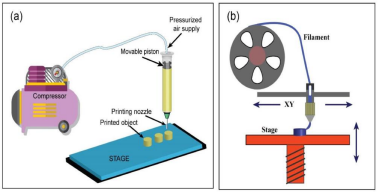
This is what we see as the primary method in drug delivery which is of the extrusion
process of a material which is either a paste or a melted filament to create layers. We
have Pressure Assisted Microsyringe (PAM) and Fused Deposition Modelling (FDM)
as the two main types. PAM which uses a semi solid paste it extrudes with pressure. It
does well with heat sensitive materials although it has low resolution which in turn
may require the use of organic solvents. FDM on the other hand uses a solid filament
which is melted and extruded through a heated nozzle. It does away with the use of
organic solvents and puts out very durable products but the high temperatures used
may cause degradation of heat sensitive APIs.
● Inkjet-Based 3D Printing:

It is like old paper printers, inkjet-based 3D printers build 3D objects by depositing
material droplets, each consisting of a portion of the final 3D object. It is subdivided
into continuous inkjet (CIJ) and drop-on-demand (DOD) processes. DOD is the most
favourable in the pharmaceutical industry, especially using piezoelectric print heads,
because it works at room temperature and therefore does not degrade active
ingredients. Further, it is classified as drop-on-liquid, wherein microstructures with
high drug loading ratios are formed, and drop-on-solid, wherein a liquid binder is
jetted onto a powder bed. The latter was used for the first FDA-approved 3D printed
drug, Spritam®. One of the major drawbacks is that the final products are often brittle,
friable, and porous.
● Laser-Based 3D Printing:

It uses a high energy laser to solidify liquid or powder materials. Two methods are
Stereolithography (SLA) which uses a UV laser to cure photosensitive liquid resins
and Selective Laser Sintering (SLS) that uses laser which fuses powdered material in a
single step, solvent free process. However the high thermal requirement in this process
may degrade the Active Pharmaceutical Ingredient (API). SLA reports very high
resolution results although it is a issue of finding FDA approved resins and also of
toxic left over chemicals. Both of these methods have restricted material compatibility
and also high price point of the equipment.
Challenges and Limitations-
3D printing of medicines is interesting, but it still meets some challenges like
● Reach Regulatory Approval: Any 3D printed medication is subject to
approval by regulatory bodies like the FDA and EMA for safety and
effectiveness. It also has to undergo rigorous Microbiological and Bulk
Powder Testing of Active Pharmaceutical Ingredients.
● Marketing and Distribution: The high costs with marketing and distribution
of the 3D printers, along with pharmaceutical grade materials, cloud the
business prospects of mass-sale printer suppliers.
● Volume Production: The ability to construct a single pill is relatively simple,
however, to scale it to millions in a short duration is extremely complex.
● Consistency: The printed pills must follow the pre exemplified prescription,
for any deviation would cause pill imbalance which can pose a significant
threat.
What's Next? A Peek into the Future of 3D-Printed Medicine
● On-Demand Pill Printing at Your Pharmacy: Imagine a pharmacy where a
patient’s customized pill could be printed and ready while they wait in
pharmacy on-demand pill printing!
● Polypills for Simplified Health Management: For the millions of people who
manage chronic conditions like diabetes or high blood pressure, taking multiple
pills daily is a fact of life. The future could bring "polypills" that are single
tablets containing all the necessary medications. This would simplify daily
routines, making it easier to manage health and stick to treatment plans.
Conclusion
The fact that 3D printing of medicines is not merely a new technology but rather a
stride towards advanced personalized medicine makes it all the more interesting. The
prospective pharmacy graduates have the added advantage of observing the pragmatic
integration of pharmacy practice with technology. Very soon, the scope of your
pharmacy practice will no longer be limited to dispensing medicines. You will be able
to actively contribute to the designing and printing of medicines tailored to the
specific requirements of patients.
References-


Comments