
Your DNA Already Stores Your Life…Could It Store Your Laptop Too? The Future of Data Storage May Already Be Inside You…


Imagine dropping your laptop…your hard drive crashes.
Years of photos, assignments, videos, and memories disappear in seconds.
Now imagine storing all of that information inside a tiny droplet of DNA.
Sounds like science fiction?
Not quite.
Scientists are already working on it.
In fact, the very molecule that stores the instructions for building you might one day become the world’s most powerful storage device.
For decades, humans have been trying to build smaller, faster, and smarter storage devices. We’ve gone from floppy disks to CDs, DVDs, USB drives, SSDs, and cloud servers. Yet throughout this technological race, nature has quietly held onto a storage device that’s billions of years ahead of us: DNA !!
Nature invented the first hard drive billions of years ago.
Every single cell in your body contains DNA.
To most of us, DNA is simply the molecule that carries our genes. But to a chemist, DNA is also one of nature’s most elegant polymers. Like many synthetic polymers, DNA is built from repeating units called nucleotides, each containing a phosphate group, a sugar molecule called deoxyribose, and one of the four nitrogenous bases :
Adenine
Thymine
Guanine
Cytosine
These four bases aren’t chosen at random. Their unique chemical structures allow them to form highly specific hydrogen bonds with one another. Adenine pairs only with thymine, while guanine pairs only with cytosine. This remarkable molecular recognition ensures that information can be copied accurately, whether nature is building new cells—or scientists are encoding digital data into DNA
A smartphone needs billions of transistors to store information.
Nature stores information for an entire human being using only four chemical letters arranged in different sequences.
That’s molecular engineering at its finest.
Unlike storing information on a silicon chip, writing data into DNA is fundamentally a chemical process. Scientists rely on a technique known as phosphoramidite chemistry, in which nucleotides are added one by one through carefully controlled chemical reactions. Each reaction must occur with extraordinary precision because even a single incorrect nucleotide could alter the stored information.
But computers don’t speak the language of DNA.
Computers understand only one language:
Binary.

Every text message.
Every PDF.
Every document and practically every piece of information eventually becomes a long stream of 0s and 1s.
For example:
010011001011…
Scientists realized something fascinating.
If computers use only two symbols
(0 and 1)…
and DNA uses four symbols
(A, T, G and C)…
why not translate one language into the other?
Using special encoding algorithms, binary data can be converted into combinations of DNA bases.
A digital image can become a DNA sequence.
A song can become DNA.
Even an entire movie can be rewritten as billions of carefully arranged molecules.
Instead of saving your holiday photos onto a flash drive…
One day they could be chemically synthesized into DNA.
So how do you “write” information into DNA?
This is where chemistry takes over.
Scientists don’t simply print DNA like ink on paper.
They chemically synthesize DNA.
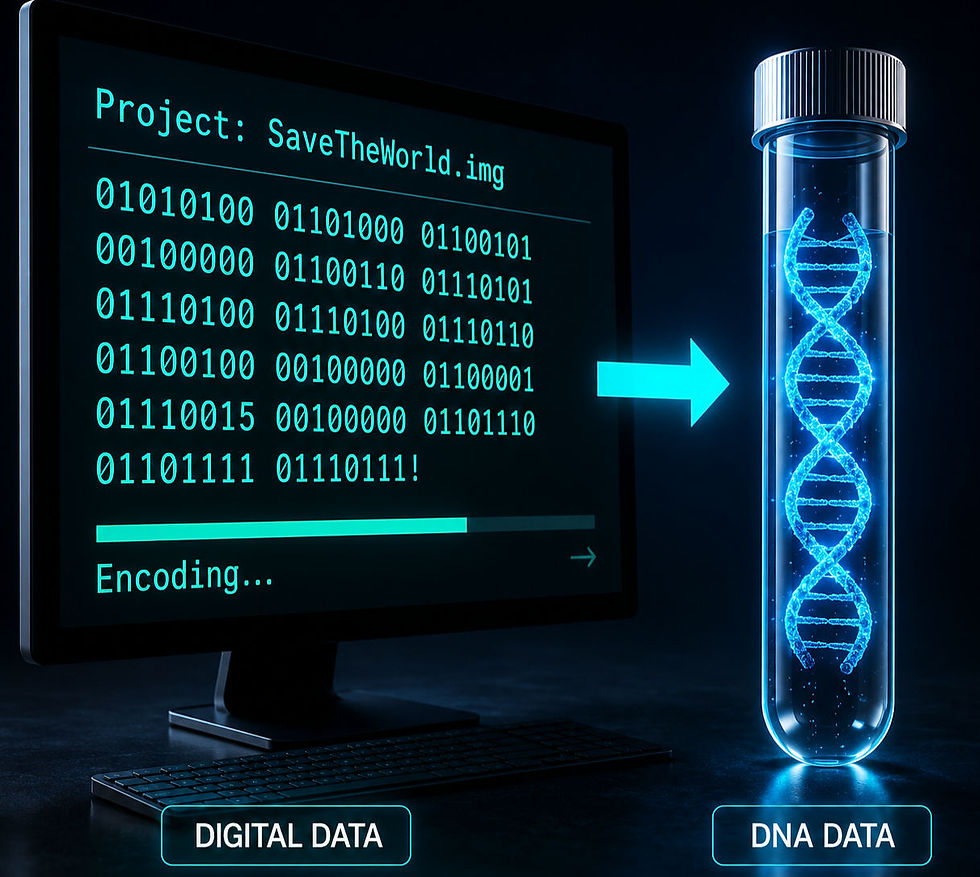
During DNA synthesis, the four nucleotides are added one at a time in a precisely controlled sequence.
Every added base represents another piece of digital information.
It’s almost like assembling an extremely tiny molecular sentence—except instead of writing words, you’re writing computer files.
Once synthesized, the DNA strand physically contains the information.
The data isn’t stored electronically this time but instead chemically.
DNA isn’t just biology anymore…
DNA is now considered one of the most versatile nanomaterials scientists have ever worked with.
At the nanoscale, DNA behaves like programmable building blocks.
Because A naturally pairs with T, and G naturally pairs with C, researchers can design strands that fold themselves into incredibly precise shapes.
This field is called DNA origami.
Scientists have built:
Tiny boxes that open only in the presence of cancer cells
Molecular cages that can carry drugs
Nanoscale switches
Miniature robots made entirely from DNA
In other words…
DNA doesn’t just store information,
It can also build tiny machines.
The storage capacity of DNA
Here’s the statistic that surprises almost everyone.
Scientists estimate that one gram of DNA could theoretically store hundreds of petabytes of data.
That’s enough capacity to hold an enormous digital library in a space smaller than a sugar cube.
Nature has spent billions of years perfecting an incredibly compact way to store information.
We’re only just beginning to learn from it.
As for what the future holds…
For decades, we’ve looked at DNA as the molecule of life.
Today, chemists, biotechnologists, and nanotechnologists are looking at it differently.
They’re asking a bold question:
“What if the molecule that stores biological information could also preserve humanity’s digital information ?”
Maybe one day, the world’s largest libraries won’t be stored inside massive data centres.
Maybe they’ll fit inside a tiny vial no larger than your fingertip.
After all, nature solved the problem of storing information billions of years ago.
Today, chemists aren’t just studying DNA to understand life—they’re learning from its molecular design. By understanding the chemistry behind one of nature’s most remarkable molecules, researchers are reimagining how humanity might preserve its own digital knowledge. The future of data storage may not lie in smaller silicon chips, but in a molecule that has quietly perfected information storage for billions of years.
-Natasha Varkey
F.Y. B. Pharm


Comments