
CELESTIAL LIGHTS: COSMIC CHEMISTRY ROOTED IN GEOMAGNETISM

Ever wondered what makes the skies in countries like Norway, Sweden, Alaska; glow on winter nights? Well, it is a molecular phenomenon, originating from the Sun as solar winds! These winds make their way to Earth holding protons, electrons, and alpha particles; resulting from nuclear fissions within the Sun’s core. Though the Earth’s protective magnetic field deflects most of these particles with the incoming solar wind, some of them penetrate the field near the poles, primarily at the points where these field lines converge. Hence, the Aurora Borealis (Northern Lights) and Aurora Australis (Southern Lights) are visible only in polar regions.
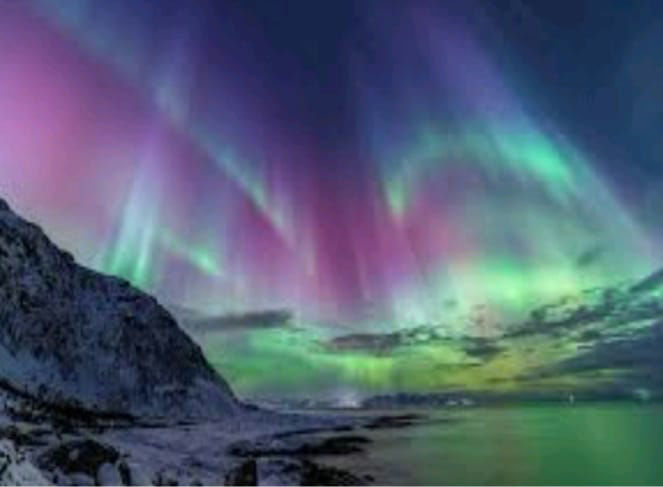

Colours of the Aurorae:
Upon entering the Earth’s atmosphere, the solar wind particles interact with the atmospheric molecules of gases, their collisions causing energy transfer from the particles to the gases. These excite the gases, causing them to transition to a higher electronic state, producing coloured hues in the thermosphere.
The thermosphere holds the following gases:
OXYGEN: In its excited state, oxygen emits green light. Brownish red-light results from less excited oxygen atoms decaying to oxygen's lowest electronic level. The variation in colours is governed by the altitude at which the collisions occur. Green oxygen aurorae are typically observed upto 150 miles in altitude. Red oxygen aurorae become visible from 150 miles upwards to 250 miles.

NITROGEN: Another glowing gas- at around 60 miles; emits a bluish- purple light, when in ionic form. The molecular form of nitrogen borders the green oxygen curtains, with a crimson hue.

The Primary Chemical Equations:
The fundamental chemistry of the aurora relies on electronic excitation followed by radiative decay, commonly termed as fluorescence.
1) Excitation: G + Solar Electron(fast) —> G^ + Scattered Electron(slow)
2) De excitation: G^—> G + hv;
Where G^ is the gas in an excited state, and hv is an emitted photon of light.
a)Green Aurorae( Lower Altitude: Oxygen)
P- Triplet state, S- Singlet State, D- Lower Energy State, hv- Green photon released.

b) Crimson Aurorae (Lower Altitude: Molecular Nitrogen)
The collisions ionise nitrogen molecule. The ionised molecule then relaxes to emit pink or violet light, often seen at the lower edges of auroral curtains.

c) Red Aurorae (Higher Altitude: Oxygen)
The atomic oxygen in the D state (a "forbidden" transition) drops to the ground state, emitting a deep red photon. This takes much longer and only occurs in the thin, upper atmosphere.

Why does the Green Light of Oxygen predominate?
Since most solar wave particle collisions occur at an altitude of 60-150 miles, the region where oxygen has the highest concentration; its characteristic excited state’s green light is visible. Interestingly, the human eye has greater ability to view the green spectrum, making its hues the most commonly visible auroral lights!
Proton Aurorae: A Rare Sighting and Shared Occurrence with Mars!
Unlike Earth, Mars lacks a global magnetic field, the solar wind piles up in front of Mars in a bow shock, which blocks charged particles from reaching the bulk of the atmosphere. As observed by the MAVEN mission, some solar wind protons can slip past the bow shock by first bonding with electrons from the Mars upper atmosphere to form hydrogen atoms. Since these hydrogen atoms are electrically neutral, they can pass through the bow shock and go on to create an ultraviolet proton aurora on the dayside of Mars.
These aurorae are rarely visible due to the naked eye their ultraviolet nature. On Earth, they are found to occur during solar storms when protons drop from the magnetosphere into the atmosphere, however, the altitude of their detection (using spectrography) is lower than the electron formed aurorae.


Conclusion:
The Aurorae are a beautiful chemical symphony, composed by electronic collisions and molecular spectra. Beyond simply being a spectacle to human eyes, they serve as a bridging phenomenon between magnetosphere studies and cosmic chemistry. From ionic and molecular interactions to energy level transitions, the aurorae share roots of pure physics and quantum chemistry.
References:
By Saakshi Sarma (T.Y.BPharm).


Comments