
The Sweet Deception: Why Artificial Sweeteners Taste Real?

A spoon of sugar, a sip of a cold drink, a piece of gum—your brain registers it instantly. It’s familiar, comforting, almost instinctive.
But what if that sweetness isn’t real?
What if the body is responding… to something that only imitates it?
ARTIFICIAL SWEETENERS !!
Have you ever wondered…
How does something with almost no calories still taste just as sweet as sugar ??
Or sometimes even sweeter ??
Artificial sweeteners are not just sugar substitutes; they are carefully designed molecules that interact with our sensory system to mimic sweetness.
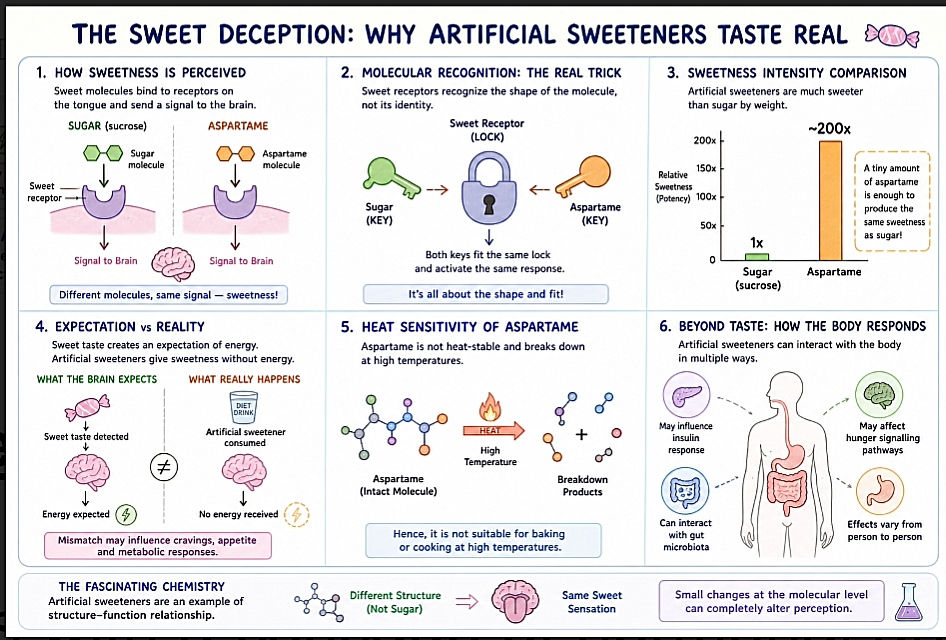
Sweet Lies: How They Trick Your Brain
Your brain is wired to respond to sweet tastes with a cascade of hormonal and metabolic reactions. When you consume artificial sweeteners, the sweet taste triggers your brain to prepare for a hit of sugar — but that sugar never comes. This disconnect can cause all sorts of chaos.
The difference between real sugar and artificial sweetness comes down to one thing: molecular interaction.Interesting, right? Something that has no sugar… can still convince your brain that it does.
At the molecular level, sweetness involves:
Taste receptors (protein structures on the tongue)
Signal transmission (nerve impulses to the brain)
Molecular binding (interaction of compounds with receptors)
The entire sensation depends not on sugar itself—but on how molecules fit into receptors.
The Chemistry Behind the Illusion
One of the most common artificial sweeteners is Aspartame.
It is composed of two amino acids:
• Aspartic acid
• Phenylalanine

Despite being structurally different from sugar, it activates the same sweet receptors on the tongue.
This is an example of Molecular Recognition.
If the molecule fits, the brain responds.
Why is it so sweet?Aspartame is nearly 200 times sweeter than sugar.This means only a tiny amount is needed to produce the same sweetness.
Higher receptor activation → stronger perceived sweetness
Less quantity → fewer calories
Sweetness without Energy! Here’s where it gets interesting…
Your brain associates sweetness with energy intake.But artificial sweeteners provide little to no energy.
This creates a mismatch between:
• Expected energy (from sweetness)
• Actual energy (almost none)
This can influence appetite, cravings, and metabolic responses over time.
Physicochemical Properties that Matter
1.Stability:
Aspartame is heat-sensitive and breaks down at high temperatures.
2.Solubility:
It dissolves easily in water, making it ideal for beverages.
3.Intensity:
High sweetness potency allows low concentration usage.
Interaction with the Body
Artificial sweeteners don’t just act on the tongue:
• They may influence insulin response
• They can interact with gut microbiota
• They may affect hunger signaling pathways
These effects vary depending on individual metabolism and consumption patterns.
The Fascinating Chemistry:-
Artificial sweeteners are an example of structure-function relationship:
Molecule ≠ sugar
Effect = sweetness
Small structural changes → large sensory impact
They demonstrate how chemistry can recreate biological signals without replicating the original substance.
Have you tried switching to “sugar-free”? Here’s what happens…
Many people feel:
-Increase cravings for actual sugar and carbohydrates
-Stimulate appetite, making you more likely to eat
-Disrupt satiety signals, so you never feel quite full
-Condition your brain to expect (and demand) high levels of sweetness
Over time, this rewires your taste preferences, making real food — like fruit, vegetables, and whole grains — taste bland and unsatisfying. You end up trapped in a cycle of craving, overconsuming, and never feeling satisfied.

The Gut Feeling You Shouldn't Ignore!
Artificial sweeteners don't just mess with your brain — they also wreak havoc on your gut. Your gut microbiome (the trillions of bacteria that live in your digestive tract) plays a massive role in immunity, weight regulation, and mood.
Studies have shown that artificial sweeteners can:
Disrupt the diversity and balance of gut bacteria
Increase insulin resistance and blood sugar spikes
Contribute to inflammation and metabolic dysfunction
So while you’re choosing the “sugar-free” option, you may actually be increasing your risk of weight gain, prediabetes, and gut-related health issues. It’s the ultimate irony — in the name of health, you’re sabotaging it.
Conclusion:
Artificial sweeteners aren’t just substitutes—they are molecular illusions.
They recreate sweetness through precise chemical interactions, convincing the brain without providing the expected energy.
A small change at the molecular level can completely alter perception.
In the end, what feels like sugar…
It is often just chemistry doing its job perfectly.
-By Glennis Joy (F.Y B.pharm)


Comments