
Lab-on-a-Chip: Miniaturizing Chemistry for Faster Diagnostics

Modern diagnostics often rely on centralized laboratories, requiring sophisticated instruments, trained personnel, and significant processing time. While effective, these systems can delay critical decision-making, particularly in time-sensitive conditions such as infectious diseases or sepsis.
In response to these limitations, lab-on-a-chip (LOC) technology has emerged as a transformative approach, integrating multiple laboratory functions onto a compact micro-scale device. By combining chemistry, biology, and engineering, LOC systems enable rapid, portable, efficient analysis and effectively decentralizing diagnostics and bringing testing closer to the patient.
Fundamentals of Lab-on-a-Chip Technology
At the core of LOC systems lies microfluidics, the science of manipulating extremely small volumes of fluids within microchannels typically ranging from 1–1000 µm. Unlike conventional fluid systems, fluid behaviour at the microscale is dominated by:
Laminar flow, where fluids move in smooth, parallel layer
Surface tension and capillary forces, dominating over gravity
Enhanced diffusion and surface interactions
These unique characteristics allow precise control over fluid movement and reactions, making microfluidic platforms ideal for integrating complex laboratory processes such as mixing, separation, and detection within a single chip.
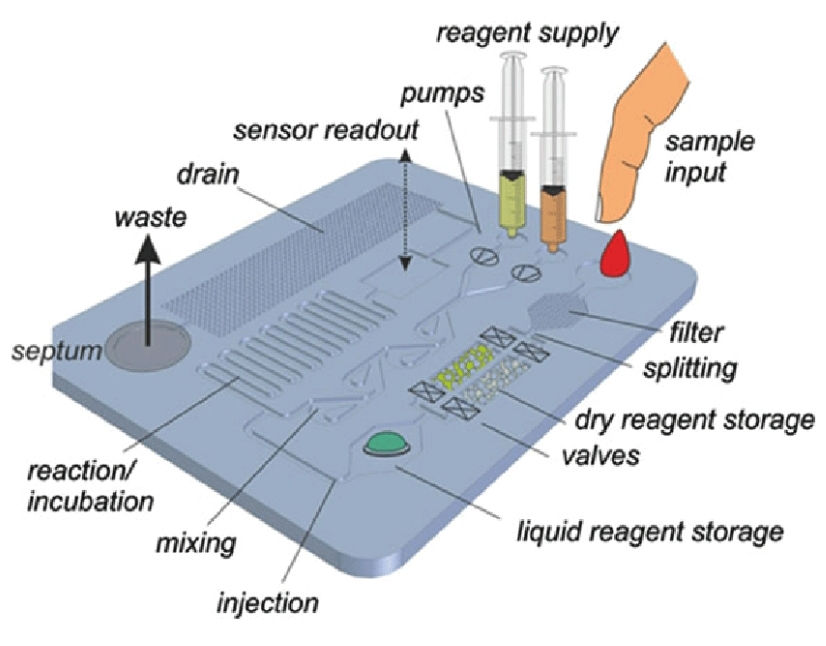
Design and Components of LOC Devices
Lab-on-a-chip devices consist of interconnected micro-scale components that replicate conventional laboratory operations. These include:
Microchannels for fluid transport
Micropumps and valves for flow regulation
Reaction chambers for biochemical interactions
Detection units (optical or electrochemical)
Materials play a crucial role in device performance. Common substrates include:
Glass and silicon – chemically stable and suitable for precise applications
Polymers such as PDMS – flexible, biocompatible, and cost-effective
Paper-based platforms – low-cost, disposable, and suitable for point-of-care diagnostics
Recent advancements also highlight hybrid systems combining multiple materials to optimize performance and scalability.
Working Principle
The operation of LOC devices follows a streamlined sequence:
Sample Introduction → Controlled Fluid Manipulation → Reaction & Analysis → Detection
Samples such as blood or saliva are introduced into the chip, where they undergo processes such as antigen–antibody interactions or nucleic acid amplification. The resulting signals are then detected using optical or electrochemical methods. The high surface-area-to-volume ratio enables rapid and sensitive analysis.

Applications in Modern Diagnostics
Lab-on-a-chip technology is widely used in point-of-care diagnostics, allowing testing outside conventional laboratories. It is widely used for detecting infectious diseases, cancer biomarkers, and cardiovascular conditions with high sensitivity and reduced turnaround time. Advanced systems such as organ-on-chip platforms further extend applications into drug development by simulating physiological environments and improving predictive accuracy.

Recent Advancements
Recent research has significantly advanced the capabilities of lab-on-a-chip systems:
Integration with biosensors for real-time detection
Multiplex analysis, enabling detection of multiple biomarkers simultaneously
Paper-based microfluidics, offering low-cost and disposable diagnostic platforms
Automation and miniaturization, allowing fully integrated systems
Recent studies demonstrate that modern LOC devices support complex operations such as nucleic acid analysis, immunoassays, and cell-based studies within a single platform. Additionally, microfluidic technologies are increasingly being combined with digital tools and portable electronics, enhancing their usability and expanding their applications in precision medicine and diagnostics.
Challenges and Future Perspectives
Despite their advantages, LOC systems face challenges such as high fabrication costs, scalability limitations, and reduced sensitivity in complex biological samples. However, ongoing advancements in materials science and microfabrication are expected to overcome these barriers, paving the way for fully automated and widely accessible diagnostic platforms.
Conclusion
Lab-on-a-chip technology represents a paradigm shift in analytical chemistry and diagnostics. By miniaturizing laboratory processes onto a single chip, it enables faster, more efficient, and accessible testing.
From healthcare to environmental monitoring, LOC systems illustrate how chemistry can be translated into practical solutions with real-world impact. As research continues to advance, these devices hold the potential to redefine the future of diagnostics and personalized medicine.
References
By Kreeti Maurya (T.Y.BPharm).


Comments