
Sweet Sparks: The Hidden Chemistry Behind Triboluminescence

Imagine biting into a wintergreen candy in a dark room and seeing tiny blue sparks flash from your mouth. Or crushing a sugar crystal and watching it emit light. This fascinating phenomenon is called triboluminescence—the production of light when certain materials are rubbed, scratched, crushed, or fractured.

Derived from the Greek word tribein (to rub) and the Latin word lumen (light), triboluminescence is one of the most mysterious and visually stunning phenomena in physical chemistry. It demonstrates how mechanical energy can be directly converted into light energy.
What is Triboluminescence?
Triboluminescence is the emission of light resulting from the breaking or separation of chemical bonds when a material is mechanically stressed.
Unlike fluorescence or phosphorescence, triboluminescence does not require an external light source. The energy comes entirely from mechanical action.
Examples include:
Crushing sugar crystals.
Breaking adhesive tapes.
Peeling certain plastics.
Fracturing quartz crystals.
How Does Triboluminescence Work?
Although scientists are still studying the exact mechanism, the most widely accepted explanation involves the following steps:
1. Charge Separation
When a crystal is fractured, positive and negative electrical charges become separated.
2. Electric Discharge
As the separated charges try to recombine, they generate a small electrical discharge, similar to miniature lightning.
3. Excitation of Air Molecules
This discharge excites nitrogen molecules present in the surrounding air.
4. Emission of Light
When the excited nitrogen molecules return to their ground state, they release energy in the form of visible light.
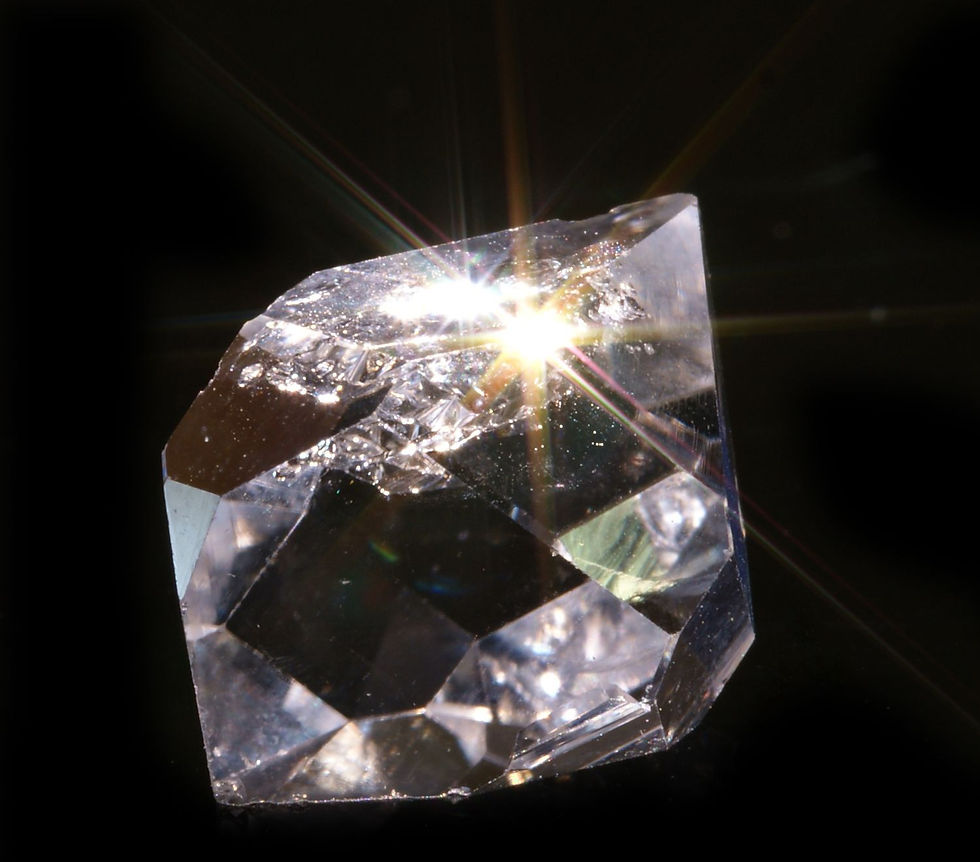
Image showing Triboluminescence of Quartz crystal.
Simplified Mechanism:
Crystal Broken
⬇
Charge Separation
⬇
Electrical Discharge
⬇
Nitrogen Molecules Excited
⬇
Light Emitted
Why Does Wintergreen Candy Spark More Than Sugar?
Ordinary sugar crystals produce tiny flashes that are often difficult to observe. However, wintergreen candies contain a compound called methyl salicylate.
When ultraviolet light produced during crystal fracture interacts with methyl salicylate, it fluoresces, converting invisible UV radiation into visible blue light.
This makes the sparks much brighter and easier to see.

Image showing glowing wintergreen candy.
The Role of Crystal Structure
Triboluminescence usually occurs in materials with asymmetrical crystal structures.
When these crystals break, unequal charge distribution develops, creating an electrical potential difference.
Materials that commonly exhibit triboluminescence include:
Sugar (Sucrose)
Quartz
Certain diamonds
Zinc sulfide crystals
Adhesive tapes
Wintergreen candies
Conclusion:
Triboluminescence is one of nature's hidden wonders—a phenomenon where simple mechanical force creates visible light. Whether it is crushing sugar crystals or biting into a wintergreen candy, this remarkable effect reveals the complex interplay between crystal structures, electrical charges, and molecular excitation.
The next time you see a tiny spark from a broken crystal, remember that you are witnessing a miniature lightning storm created by chemistry itself.
References
• Encyclopaedia Britannica - Triboluminescence.
• Walton, A. J. (1977) - Triboluminescence -Advances in Physics, 26(6), 887–948.
• Sage, I., & Badcock, R. (2014). Triboluminescence and its applications - Journal of Materials Chemistry C.
• Atkins, P., & de Paula, J. - Physical Chemistry (11th ed.) - Oxford University Press.
• Brown, T. L., LeMay, H. E., Bursten, B. E., et al. Chemistry: The Central Science (14th ed.) - Pearson.
• Chandra, B. P. - Luminescence of Solids. Springer.
By Siddhi Singh
F.Y. B.PHARM


Comments